‘Characterful, room-anchoring work of art’ - the most beautiful and timeless bathroom vanity ideas you need to save now
From repurposed dressers to Statuario marble, four top interior designers share how a statement vanity brings romance and character back to the bathroom

The bathroom vanity sees the rise and fall of every day. It anchors the quieter moments before the morning demands begin and welcomes us back as evening arrives; a place where we pause at the mirror to gather ourselves, wash away the hours, and reset.
Somewhere in the mid-century, though, we traded that ceremony for clinical utility, reducing the bathroom to sterile porcelain and uniform tiles. Thankfully, romance and texture have returned. We are once again treating the space with the same decorative weight as the rest of the home, turning to clever bathroom ideas that place the vanity as the indisputable hero of the scheme.
Below, four brilliant interior designers share how to shape, scale, and style a statement vanity piece with real soul.
The art of the bespoke silhouette

The appeal of a bespoke vanity lies in its ability to defy off-the-shelf uniformity. When designed from scratch, a vanity moves away from feeling like the standard plumbing fixtures we’re all a little tired of and becomes a tailored piece of furniture, designed precisely for the room’s proportions. It bridges the gap between joinery and art, offering a moment to disrupt the rigid horizontal and vertical lines you’d typically expect.
‘I love using a vanity as an opportunity to introduce something unexpected into a bathroom,’ says interior designer Laura Stephens. ‘Bespoke design allows you to play with shape, proportion and colour in a way that you simply can’t always achieve with a standard piece.’
By looking beyond modular dimensions, custom joinery allows designers to treat the vanity as a sculptural centrepiece. ‘I often want the vanity to feel like a piece of furniture that has been designed specifically for the room, rather than a bathroom unit that has been added afterwards,’ Laura explains. She points out that impact doesn’t necessarily require grand square footage or imposing volumes. ‘A vanity doesn’t have to be enormous to make an impact; a beautifully curved edge, an unusual silhouette or a hand-painted finish can be enough.’

The nuance lies in how these forms interact with the surrounding architecture. In a house with historic bones, introducing fluid contours, such as a gently scalloped apron or subtle radiused corners, helps soften the room’s inherent hardness. ‘In a more traditional house, I might introduce a scalloped, curved or gently shaped design to soften the architecture,’ Laura notes, ‘while a stronger geometric form can give a room a more contemporary edge.’ By playing with contours and softening hard architectural lines, a custom piece brings a human element to a room dominated by hard surfaces.
Scale, architecture, and spatial presence

In larger spaces, the main challenge is avoiding the ‘floating showroom’ effect, where individual sanitary-ware elements feel awkwardly disconnected. A well-proportioned vanity anchors the visual sightlines, grounding the scheme and giving the eye a deliberate place to rest.
Sophie Pringle, founder of Pringle&Pringle, emphasises that successful joinery begins with a holistic reading of the floor plan. ‘A bespoke vanity allows us to consider the bathroom as a whole and design the joinery around the architecture of the room,’ she notes. ‘We look at the proportions, ceiling height, sightlines and how the vanity relates to the bath, shower and other elements, rather than treating it as an isolated piece.’

When designing expansive principal en-suites, scale must be met with purpose. ‘In a generous bathroom, we don’t necessarily want a small piece floating within the space; a substantial double vanity can anchor the room and give it the sense of permanence you would expect from a beautifully designed interior,’ Sophie explains. ‘Where the space and architecture allow, we love creating a floor-to-ceiling vanity wall, bringing together the cabinetry, mirrors, lighting and bathroom storage as one considered composition.’
Conversely, in smaller bathrooms or awkward layouts, architectural features like alcoves can be turned into compelling design assets rather than spatial constraints. Nestling a vanity tightly into a niche creates a sense of intention, framing the ritual of washing as a dedicated nook.

‘We always like to approach a vanity as a piece of furniture rather than simply a functional bathroom unit,’ shares Melissa Hutley, co-founder of Hutley&Humm. She highlights how clever placement and confident colour can completely elevate an alcove zone. ‘Our mustard yellow vanity in the Surrey Country House is a good example: the colour and proportions were designed specifically for the space, allowing the vanity to become a real focal point within the room.’ By anchoring the design into the architecture, the entire nook feels elevated. ‘Placing it within the alcove allowed us to make a feature of the whole washbasin area,’ Melissa adds.
Materiality: Stone, timber, and tonal depth

A statement piece is only as compelling as the materials used to build it. The modern palette favours richness, depth, and natural patina over high-gloss, sterile surfaces. Natural stones, such as honed marbles, quartz, and travertines, bring geological art straight to the countertop, serving as a painterly backdrop to daily routines.
‘Natural stone is one of our favourite ways to elevate a vanity,’ says Sophie Pringle. ‘Marble has a depth and individuality that instantly gives a bathroom a sense of luxury, particularly when the veining is allowed to be a feature rather than treated as a purely practical surface.’
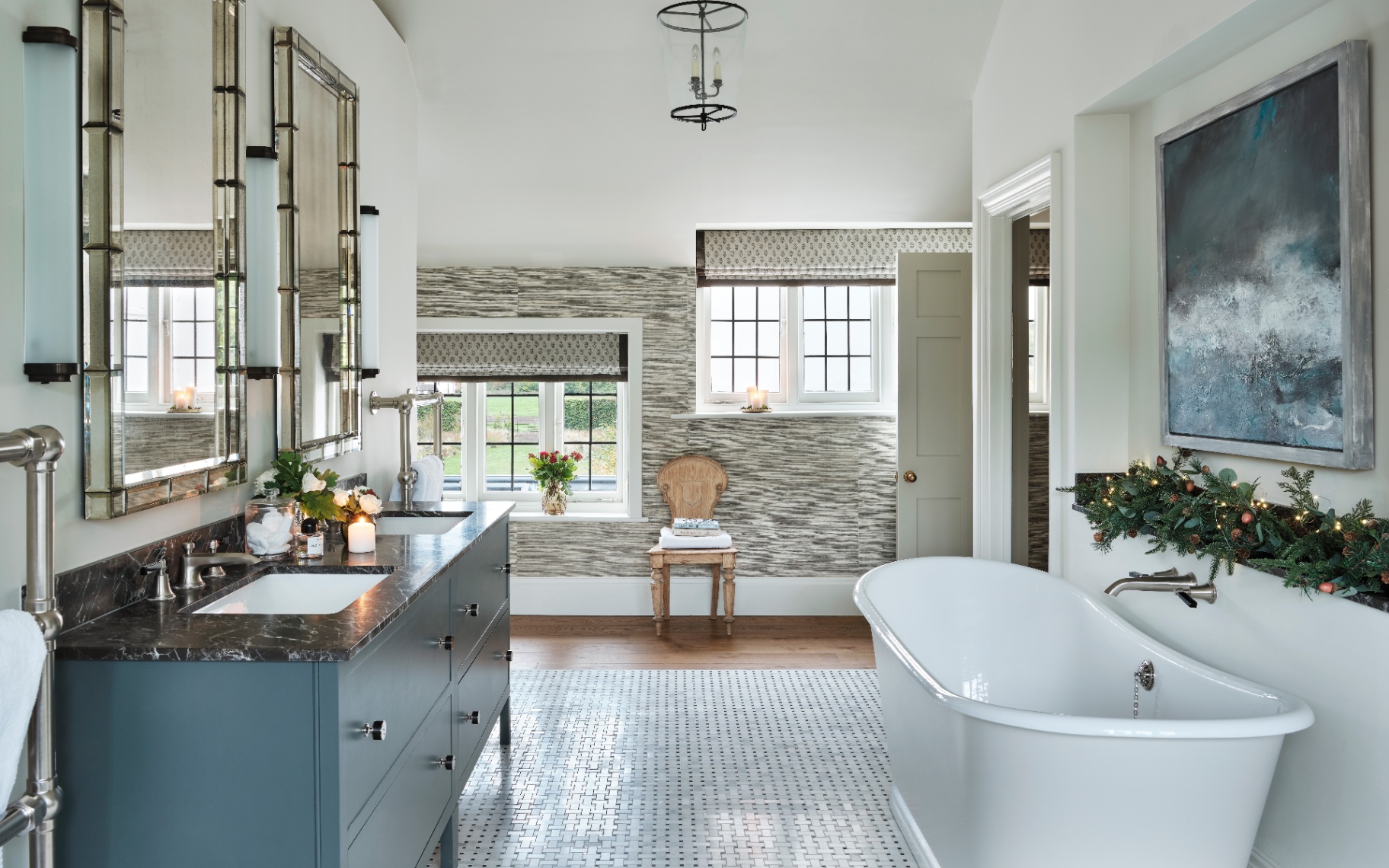
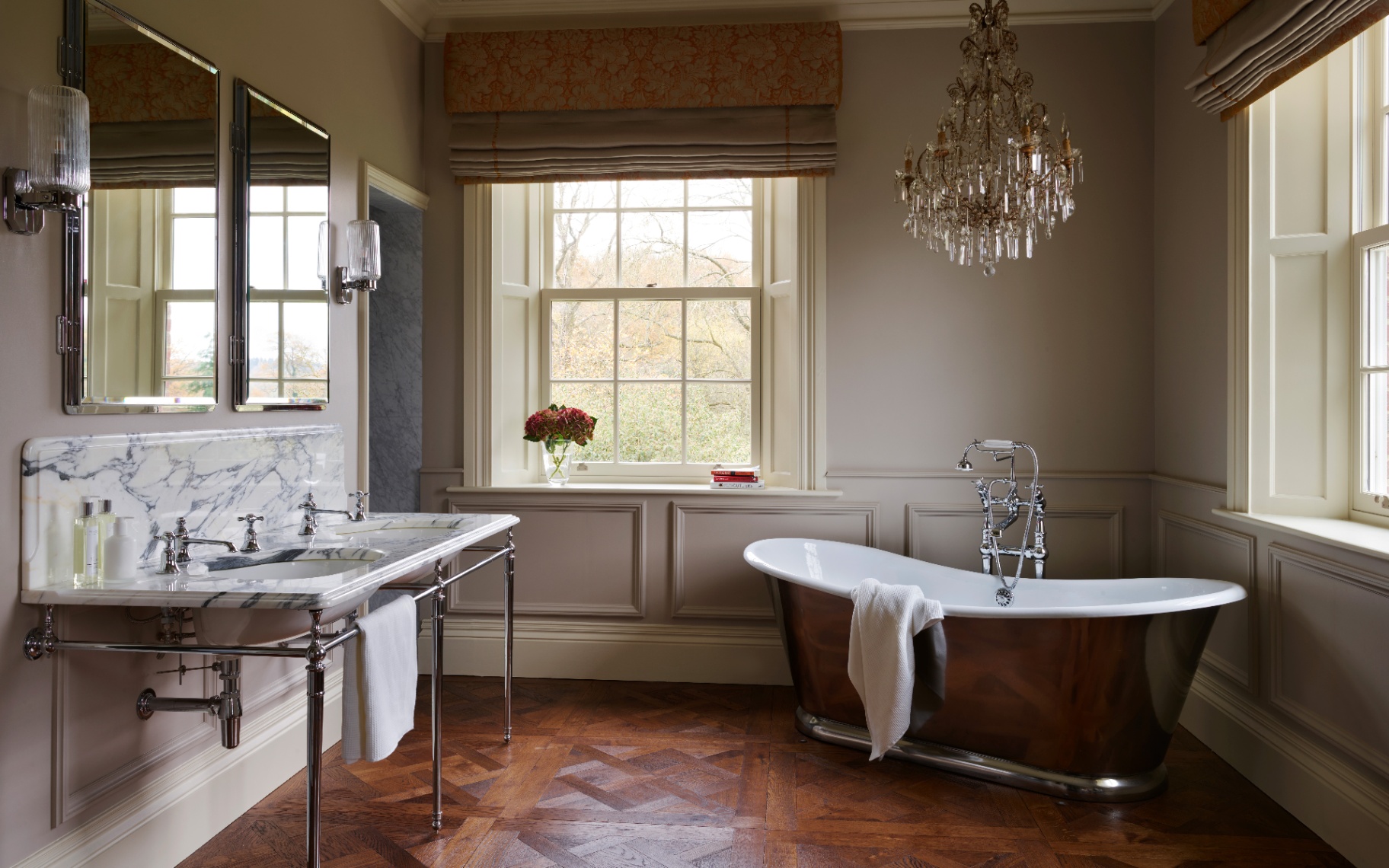
Choosing stone with pronounced movement or unique undertones creates an atmospheric base that dictates the rest of the room’s palette. ‘In our Chiswick project, the double vanity is topped with Statuario polished marble, which brings a beautiful sense of grandeur to the master en-suite,’ Sophie explains, showing how a striking slab can elevate woods or painted cabinetry underneath.

To keep a scheme from feeling overly clinical, mixing contrasting textures is key. Layering hand-painted wood against natural stone tops and unlacquered hardware creates a richness that only improves with age.
Interior designer Octavia Dickinson champions finishes that possess an organic warmth. ‘I’m drawn to materials that have a natural beauty and will develop character over time,’ Octavia explains. ‘Painted timber, natural stone, aged brass and ceramics all work beautifully together because they have texture and variation.’
Rather than aiming for perfection, celebrating small variations in material finishes gives a room its soul. ‘I would much rather have a little irregularity than everything feeling too uniform: it is those subtle differences that make a bathroom feel collected and individual.’
The repurposed antique: Bringing history to the washroom

One of the most poetic trends in bathroom design is the conversion of antique furniture into functional vanities. Drawing inspiration from classic country houses, where an old French commode, a Georgian chest of drawers, or a rustic timber console might be fitted with an under-mount basin, this approach brings a warmth that factory-fresh joinery simply cannot replicate.
‘An antique piece can bring such warmth and character to a bathroom, and I love the contrast between old furniture and the more functional elements of a bathroom,’ Octavia Dickinson observes. ‘The marks, patina and craftsmanship of an old piece give you an instant sense of history.’
By introducing pieces that carry a narrative and a past life, the bathroom loses its strictly functional identity and feels like an extension of the home’s living areas. ‘It also prevents the room from feeling too perfect or newly decorated,’ Octavia adds, highlighting how authentic wear and aged wood grain offer an immediate sense of permanence.

This philosophy is shared by Melissa Hutley, who frequently repurposes vintage silhouettes into country schemes. ‘Repurposing an antique piece is one of our favourite ways to create a vanity with real soul,’ Melissa says. ‘An old dresser or console can bring craftsmanship, patina and individuality into a bathroom, immediately making the space feel less like a conventional bathroom.’
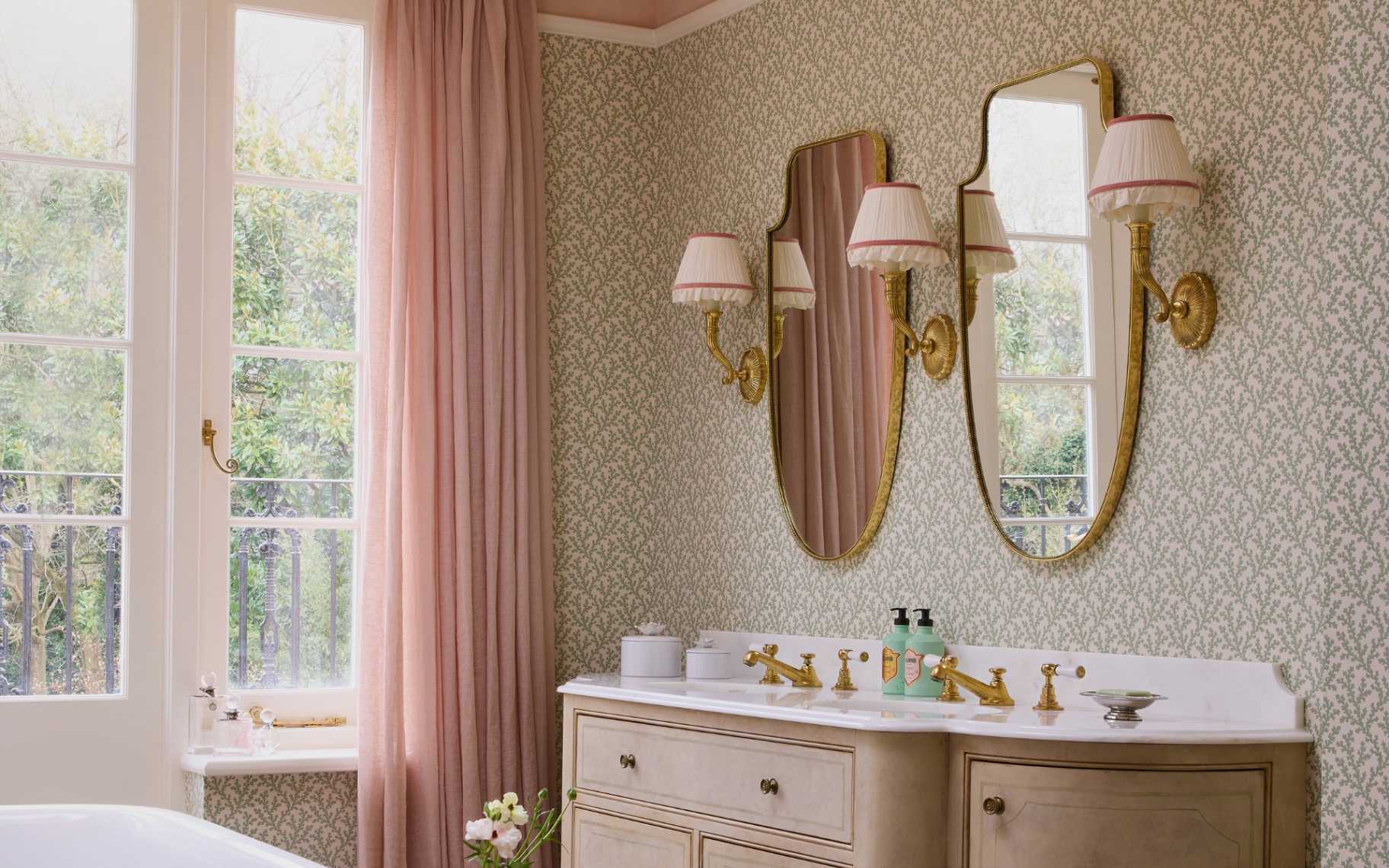
However one should move with caution: adapting antique timber for wet environments requires careful plumbing and surface sealing, but the visual reward is incomparable. ‘In Charlie’s bathroom (co-founder of Hutley & Humm), we repurposed an antique timber dresser as the vanity (see featured image), which brings warmth and a sense of history against the softer pink and peach scheme,’ Melissa explains. ‘We love the idea of taking a piece that was never intended for a bathroom and giving it a completely new purpose.’
Curation and layering: Styling the trend

Once the structural form of the vanity is set, styling around it requires the same decorative curation one would apply to a mantelpiece, a fireplace surround, or a bedroom console. Rather than cluttering the countertop with standard items, designers suggest surrounding the piece with atmospheric lighting, characterful mirrors, and carefully selected objects.
Laura Stephens views the vanity as the anchor around which the remaining decorative layers pivot. ‘I like to think about the vanity as the starting point for the whole scheme,’ Laura suggests. ‘Once you have established the colour, shape or material of the vanity, you can pick up those details in the mirror, lighting, tiles, fabrics or accessories.’

However, the key to achieving an elegant finish is restraint and variation. ‘The trick is to layer rather than match everything too literally; the bathroom should feel cohesive, but never as though it has all come from one collection,’ Laura notes. Swapping uniform sets for eclectic pairings, such as a vintage mirror paired with contemporary brass sconces, gives the scheme a decorator’s edge.
To soften the hard surfaces of tiles and stone, introducing elements typically reserved for living rooms, like framed artwork, small antique ceramic pots, or fresh garden cuttings, makes the vanity area feel warm and welcoming.

‘I like bathrooms to have the same sense of softness and decoration as the rest of the house,’ says Octavia Dickinson. ‘A mirror with character, a pretty wall light, flowers, artwork or a small antique object can completely change the feeling.’ Ultimately, the most successful styling feels assembled over time rather than staged. ‘The important thing is that it doesn’t become too contrived: bathrooms should feel useful and lived in as well as beautiful.’
A shift towards joyful design

The popularity of the statement vanity reflects a broader desire to inhabit our homes with personality, more fully and personally. We’re no longer designing bathrooms merely with an eye on value or low-maintenance utility; we’re designing them for daily pleasure, delight and ritual.
As Laura Stephens reflects, ‘People are much more confident about treating bathrooms as decorative spaces now, and I think that has opened up so many possibilities. We’re moving away from the idea that everything needs to be neutral and streamlined. A statement vanity is a relatively contained way to introduce colour, pattern and personality, and it can make a bathroom feel completely unique to the person using it.’

This shift marks a welcome return to decorative freedom, where bathrooms are given the same stylistic weight as a living room or library.
‘We’re increasingly treating bathrooms in the same way we would any other room in the house, so there’s much more appetite for furniture, colour, pattern and beautiful materials,’ Melissa Hutley concludes. ‘The vanity is the perfect place to introduce this because it can completely change the character of a bathroom without having to redesign every surface. Whether it’s a bold painted bespoke piece, a marble-topped vanity or a repurposed antique dresser, it gives the room a strong design identity. For us, a statement doesn’t necessarily mean loud: it’s about creating something with personality that feels right for the house.’
To complement your bathroom vanity, the finishing touches atop the surface matter just as much. Curate the countertop with items that elevate the everyday: NEOM’s Exfoliating Hand Wash available from Amazon to gently buff the skin, accompanied by a nourishing Aesop hand balm also available from Amazon, a flickering Diptyque candle available from Space NK, and a vintage-looking ceramic trinket tray like this one from M&S to catch delicate jewellery.
More from Bathroom Inspiration
More from The English Home